Some Bits: Nelson's weblog

Twitter Chicken Congee

I got this recipe from a tech industry friend as a JPG labelled “Twitter congee”. I don’t know if that means “seen on Twitter” or “served in the Twitter cafeteria”, either is possible. It’s very simple. Garnish with whatever: I usually use some chili crisp, some pickled mustard greens, or some sauteed vegetable like bok choy.

Ingredients

  • 1/2 pound ground chicken
  • 4 ounces sliced shiitake mushrooms
  • 1 tbsp minced ginger
  • 1/2 tbsp minced garlic
  • 1 tsp shaoxing wine
  • 1/4 tsp kosher salt
  • 1 tsp oyster sauce
  • 1 tsp fish sauce
  • 2 tsp sesame oil
  • pinch of ground white pepper
  • 6 cup water
  • 1/2 cup jasmine rice

Directions

In a bowl, combine chicken, mushroom, ginger, garlic, shaoxing wine, salt, oyster sauce, fish sauce, sesame oil and let it marinate over night in the refrigerator.

In a large pot, add water and the rice and bring it to a boil. when the water starts boiling, turn down the heat to simmer and cover the pot. 15 minutes later, stir the rice making sure it’s not sticking to the bottom. cover the pot again and stir the rice one more time 15 minutes after the first stir. cover the pot one last time and simmer 30 minutes. When the jook is done (1 hour total), it should look creamy and silky. (Nelson: that’s a long cook for the jook!)

Add the ground chicken mixture to the jook, breaking down the meat (a whisk works well). Simmer with the lid off until the chicken is cooked, about 10 to 15 minutes. Add a pinch of white pepper and enjoy!

Servings: 2 Prep Time: 15 minutes Cook Time: 75 minutes

Tex Mex Gravy

Cheese enchiladas are some of my favorite old school Tex-Mex food. Corn tortillas, orange cheese, smothered in a beefy thick gravy. The gravy is not like a typical Mexican enchilada sauce: no tomatoes or tomatillos. Instead it’s more of a Southern gravy like you’d put on biscuits or serve with turkey, but spiced with chile, cumin, oregano, and garlic powder. The key thing is it’s made with a roux. And a lot of roux, it really is a thick gravy. You never see this sauce in California or New Mexico and I suspect not in Mexico itself except maybe at the border. But it’s everywhere in Texas. it’s a defining element of Tex-Mex cuisine.

There’s an early recipe for the Tex-Mex gravy in the 1908 Gebhardt Chili Powder Company cookbook. This cookbook was written for Americans for whom Mexican food was exotic. It was written mostly to sell their chili powder, a spice blend of mild chiles (probably ancho), cumin, oregano, and garlic powder. (I made a PDF of the book from these scans.)

Salsa de Chili—Chili Gravy
This may be made of any brown or meat gravy by adding to each one-half pint of gravy, one teaspoonful of Gebhardt Eagle Chili Powder, stirring thoroughly and cooking for ten minutes. This makes a very rich sauce for fried eggs, cooked rice, baked beans, etc.

Note it doesn’t mention enchiladas. There’s no enchilada recipe in the copy of the book I have. But this is our Tex-Mex gravy! Although it’s awfully light on the spice.

Robb Walsh’s Tex-Mex Cooking has a modern version of the same gravy, see the NYT version. It’s a 4:1 mixture of chicken broth to roux with Tex-Mex spices added. Walsh’s recipe says

The lifeblood of old-fashioned Tex-Mex, chili gravy is a cross between Anglo-brown gravy and Mexican chile sauce. It was invented in Anglo-owned Mexican restaurants like The Original.

Phnom Penh street food tour

One of the best things on our trip to Cambodia in March was a street food tour in Phnom Penh led by Urban Forage. They provided a great guide and a tuktuk and driver. It was an amazing chance to try all sorts of casual snacks and meals, the kind of stuff that always looks so interesting but too intimidating to try on my own. Places were vetted for food safety for delicate Western stomachs and our guide did a great job teaching us about the food.

It was so fun and delicious! There’s some photos here and here. Cambodian food is roughly similar to Thai and Vietnamese food, but is its own thing.

First up was the “famous grandma noodle shop”, a home cooking restaurant with the kind of fish noodle soups I loved in Cambodia. This place was a restaurant with a choice of items but also very casual. We had both a chicken noodle soup and the fish noodle soup, both “curry” flavored but clearly Cambodian, not Thai. The rice noodles are super fresh, made that morning, kind of gelatinous and stuck together. The soup had such deep delicious flavor. And lots of fresh ingredients to liven it up: limes, basil, a bunch of unfamiliar herbs like fishwort.

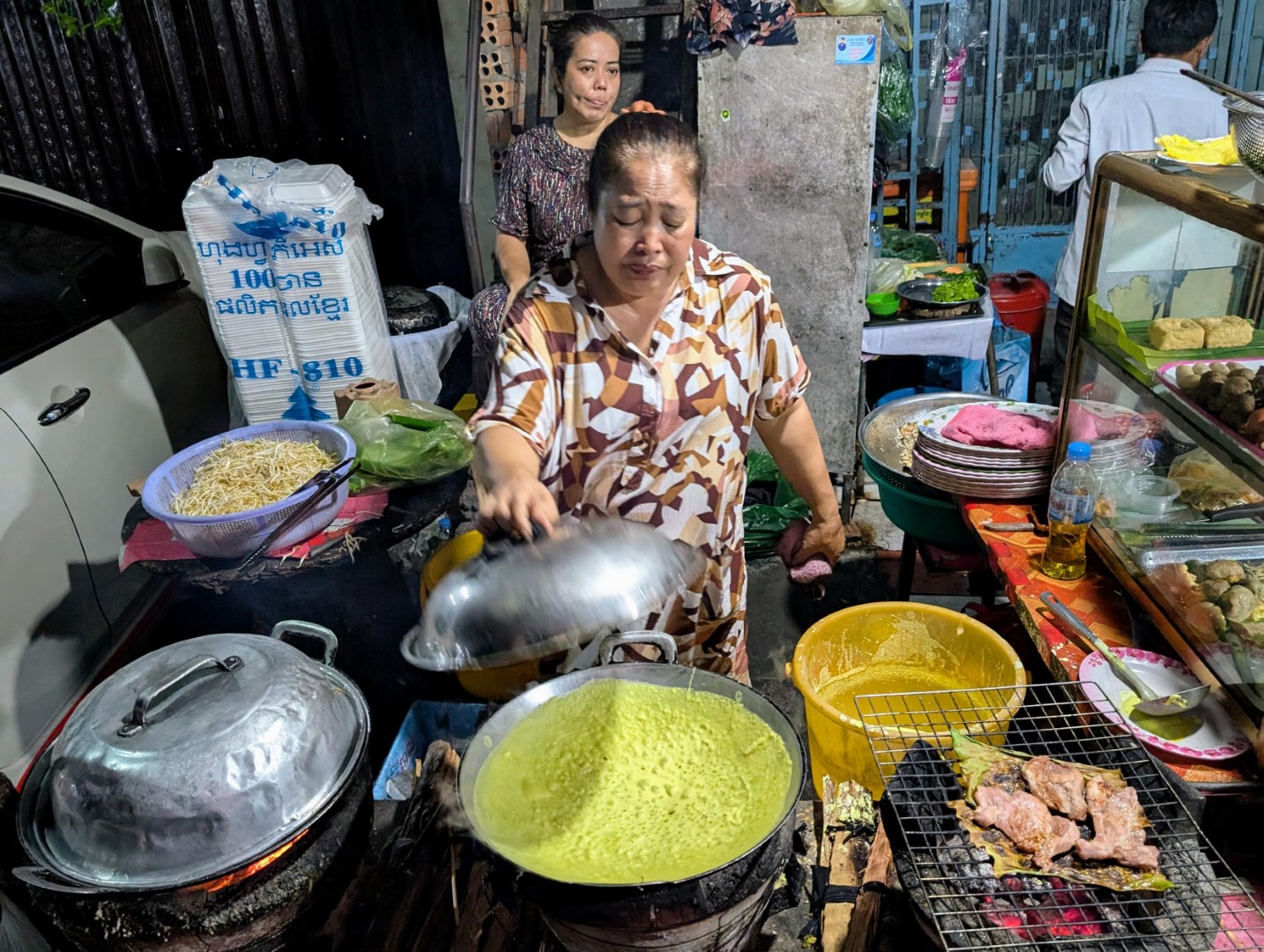
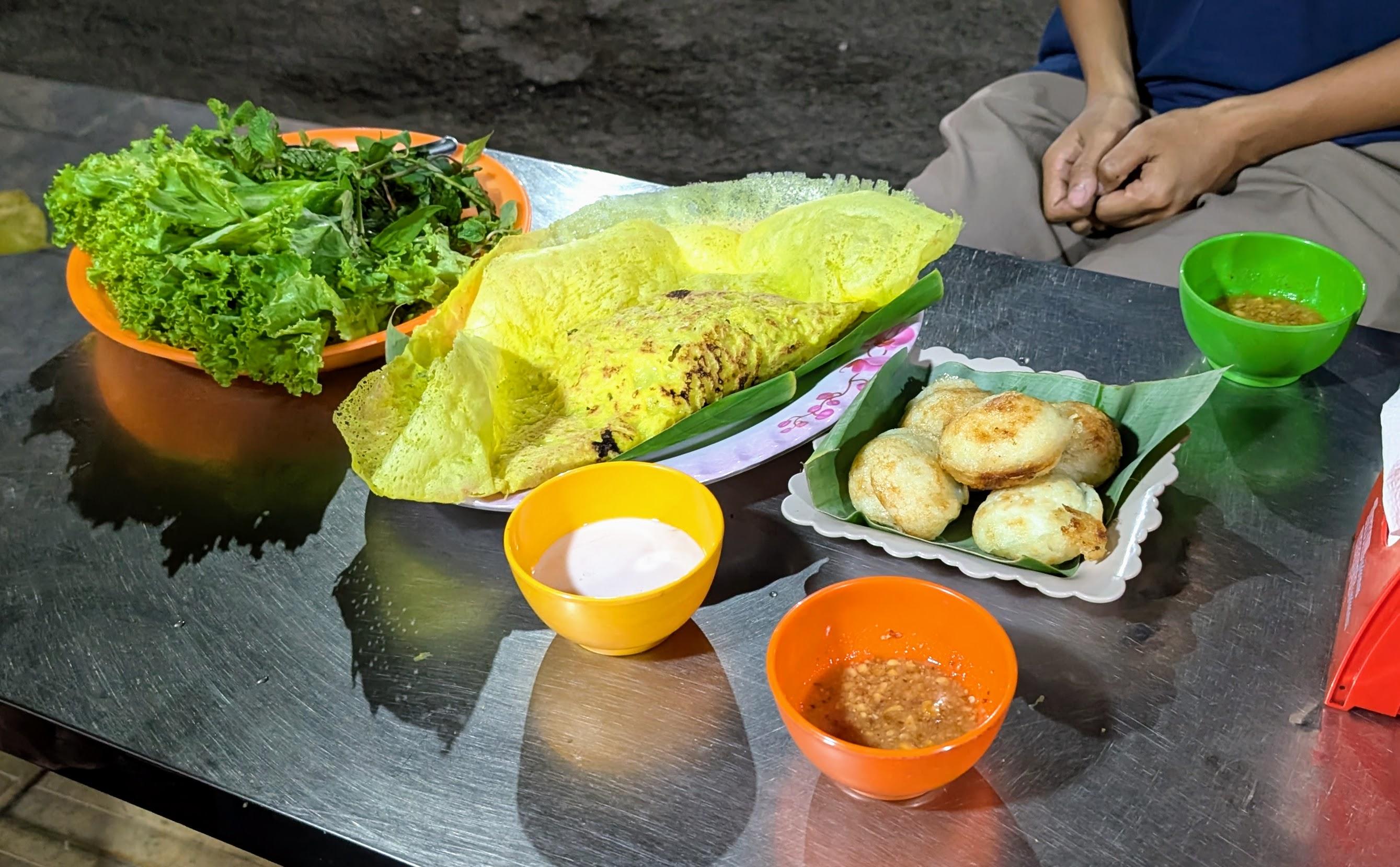
The second place was a sidewalk stand near Wat Botum Park. Rice crepe with turmeric, stuffed with chicken and sprouts, dipped in fish sauce / lime juice. Also a rice flour ball with chives in it, fried, dipped in coconut cream. it reminded me a lot of dosas and idlis. Very yummy and seemed like solid daily food.

Our third stop was for a baguette with crispy pork belly inside, some herbs, also a fresh carrot pickle. Similar to banh mi. We enjoyed it, all nice and fresh, but at this point we started to realize we were in for a long haul of lots of food.

The fourth place was in the Russian market and served barbeque. Various kinds of pork cuts, we had spare ribs. Very crispy fried and quite fat. Was too full to enjoy it all but it tasted great.

Fifth was 54ល្ងាចស្រស់ (on Facebook) a restaurant with general Khmer foods, lots of beer, and a live band. Food was a mix of things, all pretty good. My favorite was a squid salad-like dish. This was where we had the stunt food, insects. One big tarantula was OK but silly: legs were delicious like soft-shelled crab. The spicy crickets were pretty good beer snacks. The place was a bit touristy but honest, a place I could imagine going even without a guide.

Absolutely full of food and beer, sixth the guide took us to a roadside stall selling a sweet dish. A rice crepe stuffed with fresh coconut meat and a rice candy, some sweetened condensed milk. Quite tasty in its simple freshness. It was a little like this video labelled num lon ong chek.

Our final stop was a return to Western familiarity. The wild cocktail bar, a French-run place with coffee, drinks, and spring rolls. Good cocktails, nice outdoor seating.

Street food tours may be my favorite new tourist activity! We also did one in Saigon that was fun but not quite as good as this one in Phnom Penh. But in Saigon we also did a cocktail tour from this company, that was terrific.

Non-alcoholic apéritifs

I’ve been doing Dry January this year. One thing I missed was something for apéro hour, a beverage to mark the start of the evening. Something complex and maybe bitter, not like a drink you’d have with lunch. I found some good options.

Ghia sodas are my favorite. Ghia is an NA apéritif based on grape juice but with enough bitterness (gentian) and sourness (yuzu) to be interesting. You can buy a bottle and mix it with soda yourself but I like the little cans with extra flavoring. The Ginger and the Sumac & Chili are both great.

Another thing I like are low-sugar fancy soda pops. Not diet drinks, they still have a little sugar, but typically 50 calories a can. De La Calle Tepache is my favorite. Fermented pineapple is delicious and they have some fun flavors. Culture Pop is also good.

A friend gave me the Zero book, a drinks cookbook from the fancy restaurant Alinea. This book is a little aspirational but the recipes are doable, it’s just a lot of labor. Very fancy high end drink mixing, really beautiful flavor ideas. The only thing I made was their gin substitute (mostly junipers extracted in glycerin) and it was too sweet for me. Need to find the right use for it, a martini definitely ain’t it.

An easier homemade drink is this Nonalcoholic Dirty Lemon Tonic. It’s basically a lemonade heavily flavored with salted preserved lemons, then mixed with tonic. I love the complexity and freshness of this drink and enjoy it on its own merits.

Finally, non-alcoholic beer has gotten a lot better in the last few years thanks to manufacturing innovations. I’ve been enjoying NA Black Butte Porter, Stella Artois 0.0, Heineken 0.0. They basically all taste just like their alcoholic uncles, no compromise.

One thing to note about non-alcoholic substitutes is they are not cheap. They’ve become a big high end business. Expect to pay the same for an NA drink as one with alcohol even though they aren’t taxed nearly as much.

Instant Pot Ultra temperatures

I joined the Instant Pot religion. I mostly use it as a pressure cooker, but the fact you can also saute and brown things in it, simmer them, etc makes it really versatile. The cooking modes are confusing though and the pressure cooker is lower pressure than typical American electric pressure cookers.

Here’s a cheat sheet to temperatures for the Instant Pot. I believe these come from the official manual. There’s also great detail in this review.

Pressure Cooker
Low 5.8–7.2 PSI
High 10.2–11.6 PSI
Slow Cook
Low 82-88°C (180-190°F)
Medium 88-93°C (190-200°F)
High 93-99°C (200-210°F)
Custom choose 40°C-98°C (104°F–208°F)
Sauté
Low 135-150°C (275-320°F)
Medium 160-176°C (320-349°F)
High 175-210°C (347-410°F)
Custom choose 40°C-170°C (104-338°F)
Keep Warm
63-78°C (145-172°F)
Custom choose 40°C–90°C (104°F–194°F)

Note that simmering means to keep the pot just below 100°C. It’s not quite boiling, but there’s still a little steam nucleation which makes the tiny bubbles. In an Instant Pot that means Slow Cook on Medium or High, probably with the lid off.

Ken’s smoky egg and cream cheese dip

A favorite indulgent potato chip dip. It’s the mild egg flavor with a bit of smoke makes this special. We generally have it as a holiday treat but there’s nothing particularly Christmassy about it. Ken says he got the recipe from someone who worked with his Mom around 1960.

  • 1 8oz pkg regular cream cheese (room temperature)
  • 3 hard-boiled eggs
  • 1/3 cup regular mayonnaise
  • 1/2 tbsp white wine vinegar
  • 1 tsp hickory smoked salt
  • 1/2 tsp liquid smoke
  • 1 tsp dried marjoram (or basil)
  • 1/2 tsp granulated onion
  • 1/2 tsp granulated garlic
  • 1/4 tsp fenugreek (optional)
  • 1/2 tsp cayenne
  • 1 tsp Dijon mustard

Chop the eggs in a food processor fairly fine. Put the cream cheese into a wide, shallow bowl. Add the eggs and mayonnaise and mix well with a fork. Add the remaining seasonings and mix again. Enjoy with your favorite chips. This is a mild dip so plain or mild flavored chips are a better choice.

I posted this recipe three years ago but that was me trying to reconstruct it; this better version is from Ken’s own hand.

My Mom’s Texas cheese balls

One of my mother’s favorite Christmas recipes dating back to at least the 1970s were her cheese balls. Nothing unique about the cheese ball or cheese log for Christmas. But ours were specifically Texan. I have a photograph of her recipe card, here’s the ingredients. I think things in parentheses were variants.

Cheese ball (3 fist size balls)

  • 1 lb cheddar (+Swiss)
  • (3 oz blue cheese)
  • 6 oz cream cheese
  • 6 dashes Liquid Smoke
  • 1/2 t. salt
  • garlic - dried onion - 2 or 3 pinches cayenne
  • 1 1/2 Tb prepared mustard
  • Red wine or sherry 2 or 3 Tb

Her recipe didn’t include any notes on actually making it, but it’s basically "put it all in a bowl and mash it together". Grate the cheddar first (she used a sharp cheddar) and don’t be afraid to use your hands to mush it all together. To finish she would roll the balls in bright red mild paprika, mostly for the color. Sometimes in pecans but I never much cared for that.

What makes this Texan? The sharp cheddar, the liquid smoke, and the garlic/onion/cayenne that are chili seasonings. All it’s missing is cumin! (Don’t use cumin.) The prepared mustard is a bit of a curveball for a Texas dish but it’s good. And the touch of wine adds a sophistication.

I was reminded of this because Homesick Texan just posted her Aunt Betty’s cheese ball recipe. That recipe is similar to my mom’s but there are some interesting differences. I like Fain’s Worcestershire and the idea of rolling in chili powder (itself a spice blend, including cumin). Wouldn’t be my Mom’s though without the liquid smoke and I suspect the prepared mustard is doing some magic not in Fain’s recipe.

I wonder at the history that gives us these two similar Texas cheese ball recipes. Knowing my mom I’m guessing it was Helen Corbitt. Indeed Corbitt has a cheese ball recipe involving mustard and smoked cheese. And horseradish and pickled beets?! Maybe not.

Update: just made this and it’s as good as I remember. Mix the (scant) non-cheese ingredients first, then mash that into the cream cheese, and only at the end add the cheddar. The finer grated the cheddar is the better, but don’t use pre-grated; the grocery store stuff is coated with anti-caking powder. I mixed with my bare hand, the warmth helping melt the cream cheese, then froze it for half an hour to shape.

Update 2024: still good! The shaping is tricky. Roll the cheese into a ball with a water-wet hand on a counter to get it smooth. Then use your wet hand to roll half the ball in paprika on a cutting board. Then use your dry hand to handle the paprika-coated side and finish rolling to fully cover.

Doenjang Jjigae

I’ve learned to make a simple Korean stew that’s delicious and foolproof. Doenjang Jjigae (된장찌개) is a homey stew made with a flavor of fermented soybean paste, something like miso only more rustic and spicy. Serve it over rice with some banchan (side-dishes) and you have a simple reliable meal. There’s a zillion different recipes online. Maangchi’s recipe is good or see here for a second opinion.

The core flavor comes from the broth made from doenjang paste dissolved in water. The broth is easy since the flavor comes from a pre-prepared product. You can find doenjang in Asian groceries or at a markup on Amazon.

Garlic and chile is added to the broth for heat and flavor. Korean ground red chile is best (Amazon) or you can use most anything; red pepper flakes, cayenne, maybe some hot paprika for a bit of smoke. The broth can also be upgraded by starting with anchovy stock instead of plain water.

Once you have the broth you add the rest. Common vegetables include zucchini, daikon or mu, onion, fresh chiles, potato. Proteins include tofu, shrimp, clams, or my favorite: fatty pork. You can pretty much just boil everything together, although if you’re using pork you should render the fat first in the pot before making the broth.

I serve it in a bowl over short grain rice with whatever side dishes I can muster. A full banchan spread is a ridiculous amount of work. But I almost always have a jar of kimchi on hand. These marinated mushrooms are also super easy to make and delicious.

Paprika recipe app

Paprika is good software. It’s a recipe database for home cooking, just like the Honeywell Kitchen Computer. But it doesn’t cost $10,000 and you don’t have to go to Nieman Marcus to buy it; it’ll run right on your own portable telephone.

The problem Paprika solves very well is “I want this recipe on my iPhone so I can read it in the kitchen”. It also has good tools for “make me a shopping list for these three meals”, I’ve used that on the fly while standing in the grocery store.

The weird thing about Paprika is it’s not a web app. There is no web view of your recipe database. Instead there are iOS and Android apps ($5) and Mac and Windows desktop apps ($20-$30). They’re all linked to some cloud server that stores your recipes. No subscription fee.

So the part that’s clumsy is adding new recipes to your database. There’s a way to search and browse from inside the iPhone app that works OK. But mostly I find recipes on my desktop web browser. For that need there’s a bookmarklet which does a fine job of saving the recipe (and nothing else). Behind the scenes the Paprika system scrapes the ingredients and instructions out of the web page and puts them in some normalized format. That’s not easy to do but it’s worked every time for me so far.

I’m very happy with the iPhone app and use it regularly when cooking. Ken and I share a database, which seems nice. I haven’t tried the desktop apps nor have I done anything complicated with our database, it’s mostly just Pocket-for-recipes for me. I’m still a bit baffled the business is built the exact opposite of how I would have (web app, charge a subscription fee) but what they’re doing works fine, so why not?

Ken’s hardboiled egg dip

One of our holiday treats is an egg dip that Ken makes, an old family recipe. It’s sort of like smoky deviled eggs only potato chip compatible. I like it. Here’s an approximation of the recipe; it’s not an exact thing.

  • 8 oz cream cheese
  • 3 hard boiled eggs
  • ⅓ cup of mayonnaise
  • ½ tsp Colman’s mustard
  • ½ tsp liquid smoke
  • salt

Mince the eggs. Blend with mayo and cream cheese to dip texture. Flavor with mustard, liquid smoke, and salt. The result should taste mostly like eggs, with a noticeable smoky flavor and a bit of sharpness from the mustard.

You can use ordinary wet mustard but the dry mustard without vinegar is better. Minced onion or shallot might be a nice addition. Or cayenne pepper.

Sonoma Brinery pickles

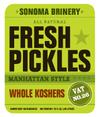
There’s two kinds of cucumber pickle in the world: fermented and vinegar. Vinegar pickles are what you generally see in the grocery store, the Claussens and Vlasics. They’re not bad but they are awfully salty and the industrial vinegar is not a very good flavor. Fermented pickles are made without vinegar. Instead the vegetable is salted and then fermented to encourage lactic acid bacteria, which makes the pickles sour.

Sonoma Brinery makes an exceptionally good fermented pickle. They’re available in grocery stores in the US west, sold refrigerated. And while they’re not cheap at about $1 a large pickle they are delicious. Great flavor and good snap. They call them “half-sour”. They have a pleasant sour taste but it’s subdued, also the salt level is quite low. The result is a mild, fresh tasting pickle, something I much prefer to Bubbie’s intensely sour and salty fermented pickles. Sonoma Brinery’s fresh sauerkraut is also delicious.

Fermented foods are newly trendy thanks to the probiotic food fad (move over, gluten free). I could care less about the fake food science but I am glad that fermented flavors are more widely available in grocery stores. I’m not a fan of kombucha, too expensive and too sweet. But sauerkraut, kimchi, etc are delicious. I’ve started trying to ferment my own things now with Sandor Katz’s excellent book.

Notes on making pizza

I’ve gotten competent at making pizza at home. It’s an easy versatile meal, 15 minutes prep time once you have the dough. I tend to make a sort of puttanesca pizza: capers, olives, anchovies, sauce from a jar (the shame) and some salami. Today was turkey leftover pizza with white sauce, I regret being too timid to try cranberry sauce after baking.

My go-to cookbook is American Pie, specifically the “neo-Neapolitan” dough variant. I’ll make a batch of 5 servings of dough and freeze 4. A stand mixer is a huge help, the dough is very glutenous. I recently learned slicing the mozzerella works better than grating, and so much easier. The dough takes time to ferment, thaw, etc but not much active work.

The challenge of home pizza is our ovens don’t go over 550°F. I get decent results in a home oven on a pizza stone, but Ken just got a Baking Steel from Sur la Table so I gave that a shot. It definitely cooks faster and chars the crust more; too much so, the bottom was about to burn before the edge was fully baked. The steel is heavy, rusts, and needs seasoning like a cast iron skillet. I’m not sure it’s a huge improvement over a clay tile.

Neapolitan-style pizza dough is pretty tempermental. For something different and foolproof this pan pizza recipe works pretty well. A no-knead dough sort of fried up in a cast iron skillet in the oven. It’s not elegant, more of a fast-food style pizza, but it’s delicious and fresh and that is its own reward.

Tex-Mex chili

One of the few things I can cook competently is Tex-Mex chili. It’s basically a pot of meat cooked with red chile and onion. No beans, no tomato. Hearty and delicious with tortillas, sharp cheddar, fresh onion, and sour cream garnishes.

I’ve learned to make chili from scratch. But if you want to cheat, Wick Fowler’s 2 Alarm Chili Kit is a reasonable compromise. It’s not as good as making it the hard way but it’s still pretty good, particularly if you bump it up with some of your own chile powder.

To make it from scratch, I use this Homesick Texan recipe. I love her blog and cookbook. It’s a very fussy recipe but makes an excellent result. Over time I’ve modified it a bit.

  • Working with all those kinds of whole chile makes a well rounded flavor but is a lot of effort (and tricky shopping). I usually end up using some powdered New Mexican red chile instead of some or all of the varieties she calls for, you just dump it in like a spice (a lot of it; more than half a cup for 4 pounds of meat if that’s all the chile you use).
  • The chipotle in adobo is the most important extra flavor and is easy to add from a can. Beyond that you want dried chiles and the extra work that entails. Cayenne is for heat, not flavor.
  • The recipe calls for chuck roast. I use half ground beef for texture. You can also use 100% ground beef which saves a lot of preparation time.
  • Leave out the clove. Too much can ruin the dish and it’s not worth the risk.
  • The beer and coffee aren’t really necessary but are nice to add some bitterness. You just need enough liquid of some sort. I use boxed beef broth instead of water.

I grew up with this kind of food.

Cass House Inn

There’s good fine dining in California’s Central Coast. Cayucos is one of those tiny California beach towns from the 50s. A few dumpy motels, a surf shop, restaurants with names like The Salty Seagull and The Rusty Pelican you’d only ever eat at because you’re on vacation in a beach town. But there’s something special and unique in Cayucos, the Cass House, and as the Michelin folks say it is vaut le voyage.

Chef Jensen Lorenzen and his crew are turning out phenomenal fine dining, as good as anything I’d expect to find at San Francisco’s top restaurants. They are serving only one option, a 14 course tasting menu of delicate little plates. With excellent (but laid back) service and a good wine list and a lovely room that only seats about 30 people.

The key thing here is the cooking works. The kitchen knows its business and is producing excellent creative food with technique but not silly gimmicks. My favorite dish was a dessert, a fennel-based gelée that was delicate, deeply flavored, with a bit of candied fennel as a crunch accent. So elegant and precise. The cauliflower “curds & whey” were also phenomenal, a rich risotto-like texture with a deep butter and cheese flavor. A heavy dish, it came after a very delicate dashi bouillon. The main course (I chose chicken) was a satisfying solid portion, keeping the whole meal from being a bit too precious and dainty. We were also very impressed at how they handled my friend’s near-vegan diet, deftly substituting coconut milk and the like for the dairy that would have been in half the dishes. (Elegant cooking without butter!) I admit I was concerned going in that the menu was too demanding, but Cass House executed incredibly well.

They’ve been doing fine dining for a couple of years but jumped full in to the tasting menu program this February. It’s ambitious and risky and one service a night at a reasonable $85 caps their business. My impression is they’re doing this because they love this kind of cooking, like being in control and preparing food with art in the way they want. I was glad to be along for the ride and hope to return.

Cooking tools

Ken is the family chef but I enjoy cooking in Grass Valley. Partly because it’s a huge kitchen with plenty of room to work. And also because we outfitted it from scratch with high quality kitchen tools. Here’s some of the stuff I particularly like using.

Wüstoff Classic Ikon knives
Solid European knives, holds an edge a long time when properly sharpened, and I love the synthetic handles. The 6” chef’s knife is what I use 90% of the time, along with a 9” for big jobs and a paring knife for detail work. Worth testing in person, you want to see if the balance feels right.
OXO Good Grips Cutting Board
I like plastic cutting boards because I can throw them in the dishwasher. This brand has the right design with rubber edges so the board doesn’t slide around.
All-Clad Stainless pots and pans
Excellent, durable, heavy cookware. The aluminum core construction is essential for heat distribution. The stainless surface is bulletproof, or at least steel-wool-proof. Expensive but they last forever and sometimes you can get a good deal on a set. The 12” fry pan, 1.5qt sauce pan, and 8 quart stock pot get the most use.
T-Fal nonstick pan
Nonstick pans are disposable, so might as well skip the All-Clad and buy a cheap one. (As careful as you try to be after a year you have a laminate of burnt grease that ruins the surface.) The good thing about T-Fal is they have a thick metal bottom that spreads heat.
OXO Good Grips stuff
For odds and ends like vegetable peelers, cooking spoons, etc. I look to Good Grips first. Most of it is nothing special (other than the cutting board I called out) but it’s well made and the grip is, indeed, good.

Neither the knives or pans are particularly cheap. But if you can afford the initial cost they’ll pay for themselves in longevity. Also most have generous warranties. In my salad days I threw out cheap pans about once every two years; we have All Clad that’s 20 years old and still in great shape.

Apologies for the spammy-sounding Amazon links; they’re for your convenience, but I do pocket a few bucks a year from affiliate fees

Camino Restaurant

Camino Restaurant in Oakland is one of my favorite restaurants in the Bay Area. I’ve been there a few times, I think every time with Marc, and every time the meal has been excellent. Worth a trip over the bridge for.

Last night’s dinner was typically great. Dungeness Crab legs, broiled on live fire with a lovely spice coating (alas, served in shell, but it’s literally the first crab of the season). Then a perfectly cooked bit of chicken three ways; moist breast, a sort of smoked leg, and a ballotine of delicious bits with strong seasoning. A little bitter greens, a little rustic grain (farro?) to catch the sauce, simple and refined. I even had dessert, a dense little persimmon pudding with just a bit of quince for sweetening, very savory and satisfying. Excellent cooking, well balanced.

Art of Eating had a profile of Camino a couple of years ago (issue #89) that I can loan you a copy of if you’re really curious. The article’s focus is on their cooking with live fire, which is indeed quite homey in the open kitchen. But while the technique impresses me I think its true value isn’t in the smoke but rather in forcing the chef to be attentive and careful to every single dish. Combine with excellent ingredients and a sense of what makes a delicious, restrained meal and it’s good dining.

Camino is run by Russell Moore and Allison Hopelain. It’s on Grand Ave in Oakland. You need a reservation.

Keurig single cup coffee brewers

The Keurig B60 single cup brewer makes good coffee. I’m not much of a coffee snob and am perfectly happy with any decent American brewed coffee. For me and Ken, this K-Cup brewer gizmo is better than a generic drip coffee pot.

The main advantage is convenience. We can have a cup of hot fresh coffee in about three minutes; faster if the machine is already on. Any time of day, without the hassle of making a fresh pot (or, guiltily, microwaving leftover coffee). The other advantage is consistent quality. The coffee just tastes better, I think partly because of freshness and partly because of precise temperature control during brewing.

The downside is cost. Even in bulk, my preferred coffee is about $0.65 / 10oz mug. That’s about double what I paid for drip coffee made with decent beans from my local coffee shop. You can use your own cheaper grounds in refillable K-Cups (the ekobrew works OK), but a bit of grit gets through and it’s a hassle to fill and clean. The brewer itself is also expensive, but it’s a surprisingly complicated and well made machine.

Keurig sells a confusing variety of K-Cup systems and now has a new incompatible system called Vue. The B60 special edition looked like the right feature set to me, although I’m already wishing I had some way to hook it directly to my plumbing so I don’t have to fill a water tank.

Update: thanks to Adam for pointing out that the K-Cup patent expires in September. The price of a cup should go down then, it also probably explains why Keurig just introduced an incompatible new system with no obvious major benefits.

Eleven Madison Park

The best meal we had in New York was at Eleven Madison Park. It was one of the most impressive meals I’ve had anywhere in the world and nicely complements one of the other finest meals I’ve ever had in my life, in 2004 at Campton Place. Same chef, Daniel Humm.

Eleven Madison is operating at a very high standard right now. If you live in New York or are going to visit make the effort to go: you need to reserve weeks in advance. They received four stars in the NYT two years ago and just recently got 3 stars and 5 forks in the NY Michelin guide. I had dinner there a year ago right after they switched to the current tasting menu and it was very good but not transcendent. In the past year they’ve found their stride and it is now as good as dining gets, anywhere in the world. Go.

Our meal consisted of some twelve amuse bouche followed by a four course tasting menu meal. The menu is deliberately abstract, just a list of main themes like “Lamb” or “Apple” that are elaborated based on the staff’s reading of the diner’s desires. An open mind is useful but they’re not playing any games, no need to fear some unwelcome surprises. The cooking leans towards traditional, not molecular gastronomy trickery, and excels by being very well executed.

Langoustine: Marinated with Grapes, Fennel, and Marcona Almonds
White Truffle: Tortelli with Fontina Val d’Aosta and Chestnuts
Guinea Fowl: Roasted with Pear, Salsify, and Foie Gras
Apple: Ice Cream with Toffee Cake, Walnuts, and Caramel

Foie Gras: Terrine with Plum, Bitter Almond, and Umeboshi
Lobster: Poached with White Truffles, Autumn Mushrooms, and Spinach
Guinea Fowl: Roasted with Pear, Salsify, and Foie Gras
Blue Cheese: With Pear, Chestnut Honey, and Bitter Greens

1995 Meursault Les Meix Chavoux (Domaine Roulot)
1996 Corton-Bressandes (Domaine P. Dubreuil-Fontaine Père & Fils)

Sadly I have no record of the various amuse, they were extraordinary in their variety and complexity. The main courses were nicely paced and undiluted, each enjoyable and complete without being overwhelming, Often at a fine meal like this by the time you get to the poultry you’re tired and just want to stop eating; Eleven Madison avoided fatigue.

But food is only half of fine dining, the room and service is the other half. And it’s extraordinary. Terrifically personal and friendly service, not too formal, but very professional. I’d gotten the reservation by gushing on about having been to Humm’s restaurant in San Francisco and was impressed the staff all knew my story. We even got a little visit to the kitchen, always fun, amazing to see as many cooks in the kitchen as there were diners in the room. All working precisely, neatly, for our pleasure.

Chef Humm is buying the restaurant from Danny Meyer, along with his General Manager Will Guidara. That’s probably good news, but I’m a bit concerned that they are also taking on food and beverage at a nearby hotel. The best chefs always expand their empires, it’s natural for his career, but I fear the risk of diluting his excellence. Did you know Wolfgang Puck used to do something other than frozen pizzas? They are also publishing a cookbook due Nov 11 (see video). We saw a pre-release copy. It looked beautiful and entirely impractical for the home cook, more of a monument to his art like Keller’s French Laundry Cookbook.

The tyranny of Tabasco

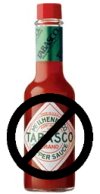
It’s time to have a grownup talk about hot sauce. If you go to a generic American restaurant and ask for hot sauce, you will be brought Tabasco. And it’s a terrible choice, the worst kind of hot sauce.

Tabasco is a Louisiana hot sauce. Like its cajun brothers the primary flavour in Tabasco is vinegar. There’s chile, too, but it’s secondary. Vinegar sauces have their place, particularly in barbeque and cajun cooking. But Tabasco is the worst of the Louisana options: the vinegar is some industrial product with a one dimensional acid taste and the chile barely adds any flavour. If you want a Louisana style hot sauce try Crystal, Lousiana brand Hot Sauce, or Wintzell’s sauce (made by Panola). They all have much better flavour: interesting vinegar and decent chile.

Vinegar is a poor seasoning for most American food, particularly anything with eggs and any of the Mexican-derived food we get in California. American restaurants should generally offer Mexican hot sauce. Mexican sauces are made primarily with chiles and water. There may be a little vinegar and spice for flavour but the acidity doesn’t dominate. There’s a zillion options for Mexican hot sauce but a few good common options are Tapatío, Melinda’s, and Cholula.

I also want to give a shout out to Sriracha, the modern, Vietnamese-American hot sauce whose thickness, sweetness, and intense garlic flavour give an interesting third option. I find its seasoning too strong to use as a general condiment but it’s a delicious alternative to ketchup or mustard for flavouring sandwiches.

Summary: you probably want Mexican hot sauce, not a vinegar sauce. If you want Louisana hot sauce, avoid Tabasco.

Sous vide at home

Awhile back I posted some quick thoughts on a new kitchen gadget we got, a sous vide cooker. We’ve had it a couple of months now and my final opinion is it’s useful but I’m not sure it’s worth the expense and space. Ken does the cooking; he likes it.

Sous vide is the process of cooking food, particularly meat, slowly at low temperature in a sealed bag. The great appeal of sous vide is it’s really simple to get consistent results. Want a medium rare steak? Set the temperature to 55°C, toss some beef in for 2-72 hours (depending on cut), and out comes a perfectly cooked medium rare beef. Hamburgers, fish, poultry, eggs, all easy to cook to a consistent texture.

In some sense sous vide cooking is the mirror twin of barbeque. But what it doesn’t do is add flavour. Traditional hot cooking sears, caramelizes, browns, burns, and generally imparts complex flavours to food. Sous vide doesn’t do that. So you have to brown the meat after cooking it. But the browning is tricky; you can’t do it too long lest you overcook it. (Spicing is also tricky; some spices taste different after being cooked sous vide). We’ve yet to get a really good crust on a sous vide steak.

If we had no idea how to cook a steak properly the sous vide would be a miracle. Or if we needed to turn out forty steaks a night consistently, it would be a huge help. But Ken already knows how to cook a great steak on a grill, in a skillet, or in an oven. So now we’ve got a fourth way, with some drawbacks, and I don’t quite see the point.

One strength of sous vide is that it’s not a dry process. Chicken and pork come out beautifully tender and moist. It’s a great way to salvage the flavourless fat-free industrial meat we get in the US. I also shouldn’t understate the value of the convenience; Ken really likes not having to worry about timing the meat completion along with everything else. And it’s easy to cook something, store it in the fridge, then finish it with a quick sear days later.

The home appliance of choice is the SousVide Supreme, $400 on Amazon. It’s a well made appliance, good construction and works well although I wish they’d done a better job on the lid insulation. It’s far too large for meals for 2–4 people, but the demi version they offer isn’t significantly smaller or cheaper. You also need a vacuum sealer; any air left in a bag at all will cause it to float and cook inconsistently. The package deal is $470, a significant expense. If you don’t already own good knives and cookware, buy those first.

Sous vide quick thoughts

We bought a sous vide cooker. We only got it yesterday and all I’ve cooked in it was an egg, but already I’ve got some thoughts.

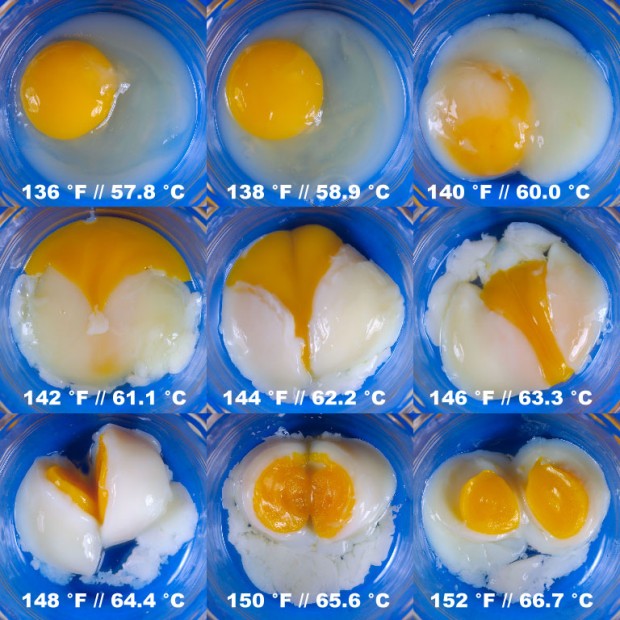
The appeal of sous vide cooking is easy precision. You dial in a specific temperature to a water bath and let your eggs, or meat, or veggies hang out for an hour or two at that temperature and you get perfection. The variance in temperatures is amazing. Eggs go from runny (but pasteurized) to hard between 58°C and 70°C. Beef goes from rare to medium between 51°C and 60°C. Traditional cooking on a hot stove requires the cook control the final temperature with time. Sous vide lets the cook just set an exact temperature and forget it; there’s no risk of overcooking. For someone like me with no kitchen skills, that’s very appealing. But so many caveats.

First, sous vide cooking is slow. A hamburger takes 2 hours. A big chunk of meat can take 2 days. It cooks entirely unattended but you do have to plan ahead. A related problem is you can only cook to one temperature; no cooking both your meat and your veggies in the same bath. And when the sous vide step is complete you’re not finished. Meat still has to be browned or seared, and seasoned, and finished. And while an egg yolk may come out creamy at 63°C if you want a firm white you need a final hot boiling step (carefully timed).

The other issue is equipment. The Sous Vide Supreme we bought is pretty well built, but at $450 it’s an awfully expensive gadget. It takes up a lot of space. And you really want a vacuum bag sealer to go with it, another gadget. I fear if we store the kit away next to the mixer, the food processor, and the blender we’ll never use them.

I’m optimistic the sous vide cooker will get some good use in the house. It’s simple enough even I might be able to cook well with it. But it’s got some drawbacks.

Wine cellar software

It took a year and a half, but I finally catalogued and put away our wine. All 448 bottles: 80% reds, 40% Bordeaux/Cabernet, 50/50 US/French.
There’s a lot of bad wine software out there. I looked long and hard for a good web based wine inventory solution before settling on CellarTracker / GrapeStories / cor.kz. I have two specific goals for wine cellar software. It needs to be easy to enter purchases. And it needs to quickly answer questions like “do I have a nice old Bordeaux?” or “where is a cheap Chardonnay for tonight?”. It’s astonishing how few cellar apps solve those problems. There’s iPhone apps that expect you to type in all your wines on the phone! And no app does a great job on the “find a wine” problem. I like CellarTracker best, but some good alternatives are VinCellar and ManageYourCellar.

CellarTracker has been around a long time, it’s got a huge community of wine enthusiasts. The website shows its age, you can feel the SQL queries being built up as you navigate the user interface (OTOH, it’s very powerful.) There’s a more humane user interface in beta now, GrapeStories, which provides a modern AJAXy interface to the same backend database. There’s also cor.kz, an iPhone app that also uses your CellarTracker account as the backend. Great for quickly finding a wine without using a computer.

One amazing thing about CellarTracker is the depth of the database. Wine canonicalization is a tricky thing, there’s no universal identifier like a UPC or ISBN. So you have to type in “Leroy Vosne-Romanée” and then sift through the seven or so variants to get the right one. They have a great search UI for finding your wine. Only about 7 of my wines were missing, all unremarkable novelty wine. And now that everything is identified I can take advantage of their vast library of tasting notes, recommended drinking dates, pricing, etc.

CellarTracker has a lot of features, I’m just scratching the surface. Bar codes, printed reports, shopping pointers. And I haven’t even looked into the community yet. Given how much money is spent on wine you’d think someone would have sewn up the Internet wine market already. With the new UI at GrapeStories I think it may be on its way.

PS: I almost passed on CellarTracker because it stores your password in the clear. That’s a pretty terrible sin but they’re quite clear on disclosing the problem and the author is remorseful. I finally decided just to use a unique throwaway password for just this site.

One Flew South, Atlanta airport restaurant

Ken and I had two excellent meals at One Flew South, a serious restaurant in the Atlanta airport. Concourse E, in the secure zone, easy to get to from any of the terminal buildings. It’s not cheap ($15-$25 main courses) and not particularly quick (an hour minimum), but if you’ve got a couple of hours to kill at the Atlanta airport and you want a fine meal, One Flew South is the place to go. They also have a great cocktail selection at the bar if you just want a nice drink.

The menu is pleasantly eclectic with a welcome attention to local artisanal ingredients. They bill themself as Southern-influenced international. The best dish I had was a pulled duck sandwich. Exactly like a pulled pork Georgia BBQ sandwich only with lovely duck confit, a fine marmelade, and good fresh bread. Also had a well balanced frisée salad with excellent local bacon and a surprisingly great sushi roll. They even have a cheese plate, three pleasant Georgia cheeses. Local ingredients and a careful chef, miles away from the Chili’s / TGIFridays / Sbarro horror of the usual airport dining experience.

Service was friendly and professional. A bit uneven in the pacing, particularly for drink service, but the friendliness made up for it. They were nicely accomodiating about returning a corked bottle of wine. It’s a good dining room, too, a comfortable and pleasant private space separated from the terminal by a wood screen that creates privacy while letting you still watch the people walking by. Concourse E seems to be the new international terminal in Atlanta and is quite civilized, particularly the live piano playing in earshot of the restaurant.

The executive chef is Duane Nutter; the other principles are chef Todd Richards (also of Rolling Bones BBQ) and manager Jerry Slater. I imagine it’s difficult to run a fine restaurant in the secure zone of an airport. High rent, awkward delivery logistics, and a bizarre and changing customer base. I sure hope they’re doing well because I’d love to go back.

The tyranny of sourdough

As I write this post my mouth is coated in the sour, unpleasant aftertaste of a sourdough English muffin. It’s breakfast: a little butter, a little Italian honey, and a crunchy muffin. Why is my muffin sour?

It’s sour because in the US, particularly in San Francisco, it’s hard to buy good bread. About 75% of the decent bread in my grocery store, both fresh baked and industrial, is sourdough. Consumers think sourdough is shorthand for quality. It’s not. In fact, sourdough is seldom the appropriate bread for a meal. It makes lousy sandwiches, lousy breakfast, it clashes with cheese. It’s good with creamy soups, and it’s good plain with butter. But the premium bakeries all push sourdough, and so sourdough becomes synonymous with “good”, when it’s not.

The flipside of sourdough is hideous American industrial bread made out of sugar. Sugar has no place in bread. OK, maybe a pinch to proof the yeast. But bread should not be sweet. Pretty much every industrial bread in my grocery store is sugary; particularly second-rate breads like hot dog buns. Yuck.

Mail order steaks

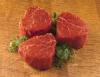
After being vegetarian for nine years I think I particularly appreciate a good steak. And the best we’ve had at home are mail order filet mignon from Kansas City Steak Company. Beautiful texture, good beefy flavour, consist cuts. $25/pound isn’t cheap but isn’t terrible and as advertised the “triple-trimmed” means you really don’t need to cut anything at all away before cooking.

There’s lots of mail order steak options. We’ve tried many and these are by far the best. Significantly better than what we can get in our local high end grocery store, too.